Top 3 Alternatives of 15Five for Performance Management
Your performance review cycle is due next month, and 15Five's check-in features no longer match how your team actually works. The gap between engagement surveys and real-time feedback keeps widening, forcing you to evaluate alternatives. By the end of this guide, you will have a concrete comparison of three tools, clear criteria for matching features to your team's workflow, and a definitive #1 pick for performance management.
We focus on what matters most when switching platforms: core performance features, pricing scalability, and the practical limitations of each option. You will leave with a decision framework that filters out marketing noise and points you to the right fit, whether you prioritize continuous feedback, goal tracking, or a unified engagement hub.
What to Look For in 15Five Alternatives for Performance Management
When evaluating 15Five alternatives, focus on the features that directly impact your team's performance management outcomes. The right platform should streamline your existing processes rather than force you to adopt a completely new philosophy. Start by mapping your current performance cycle, from goal setting to performance reviews, and identify where your team struggles most.
Consider how each tool handles continuous performance versus periodic evaluations. Some platforms excel at daily check-ins and real-time feedback, while others prioritize formal performance appraisal cycles. Your company culture and management style should guide which approach fits best.
Pay close attention to the user experience for both managers and employees. If a tool feels cumbersome, adoption will suffer regardless of its feature set. Look for platforms that reduce administrative burden and make giving employee feedback feel natural rather than forced.
Finally, think about the long-term trajectory of your organization. A tool that works for a 20-person team might feel limiting at 200 employees. Consider how each alternative supports goal alignment across departments and whether it can grow with your evolving talent management needs.
Core Performance Management Features to Compare
Compare features like continuous feedback, goal tracking, performance reviews, 360-degree feedback, and engagement surveys to see which platform fits your workflow. Each of these capabilities serves a distinct purpose, and the best alternative for you will balance them according to your priorities.
Continuous feedback and check-ins keep conversations flowing between review cycles. Look for tools that allow managers and peers to share real-time feedback easily, whether through comment threads, quick prompts, or recognition features. The goal is to capture insights while they are fresh and actionable.
OKR software and goal setting help align individual work with company objectives. A strong platform should let you create measurable objectives, track progress visually, and cascade goals across teams. Consider how intuitive the goal alignment process feels for employees who may not be familiar with OKR frameworks.
Performance reviews and performance appraisal tools should support multiple review types, including self-assessments, manager evaluations, and peer feedback. Look for customizable templates that match your existing review process. 360-degree feedback is particularly valuable for leadership development, as it gathers input from direct reports, colleagues, and managers.
Pulse surveys and engagement surveys measure workplace sentiment between formal review periods. These tools help you spot trends in employee engagement before they become problems. Finally, workforce analytics and reporting dashboards turn raw feedback data into actionable insights for HR leaders and managers.
Pricing and Scalability Considerations
Pricing models vary, some charge per seat monthly, others offer annual discounts, so calculate total cost as your team grows. Most performance management platforms use a per-user pricing structure, which means your monthly bill scales directly with headcount. This is straightforward but requires careful forecasting as you hire.
Look for tiered pricing plans that unlock additional features at higher price points. A basic tier might cover check-ins and goal tracking, while advanced analytics or 360-degree feedback tools may require a premium plan. Assess which features are essential versus nice-to-have for your current stage.
Watch for hidden costs beyond the base subscription. Some vendors charge onboarding fees, implementation costs, or extra for dedicated support. Ask about the flexibility to add or remove users mid-contract, especially if your team size fluctuates seasonally.
When comparing pricing against features, create a simple scorecard. List the capabilities your team needs most and check which platforms include them at each price point. Enterprise plans often offer custom pricing, so negotiate based on your specific requirements rather than accepting published rates.
Scalability is about more than just cost. Consider how easily the platform handles organizational changes like department restructuring or new reporting lines. HRIS integration becomes increasingly important as your company grows, so verify that any alternative connects smoothly with your existing HR software stack.
1. HeyRamp - Best Overall
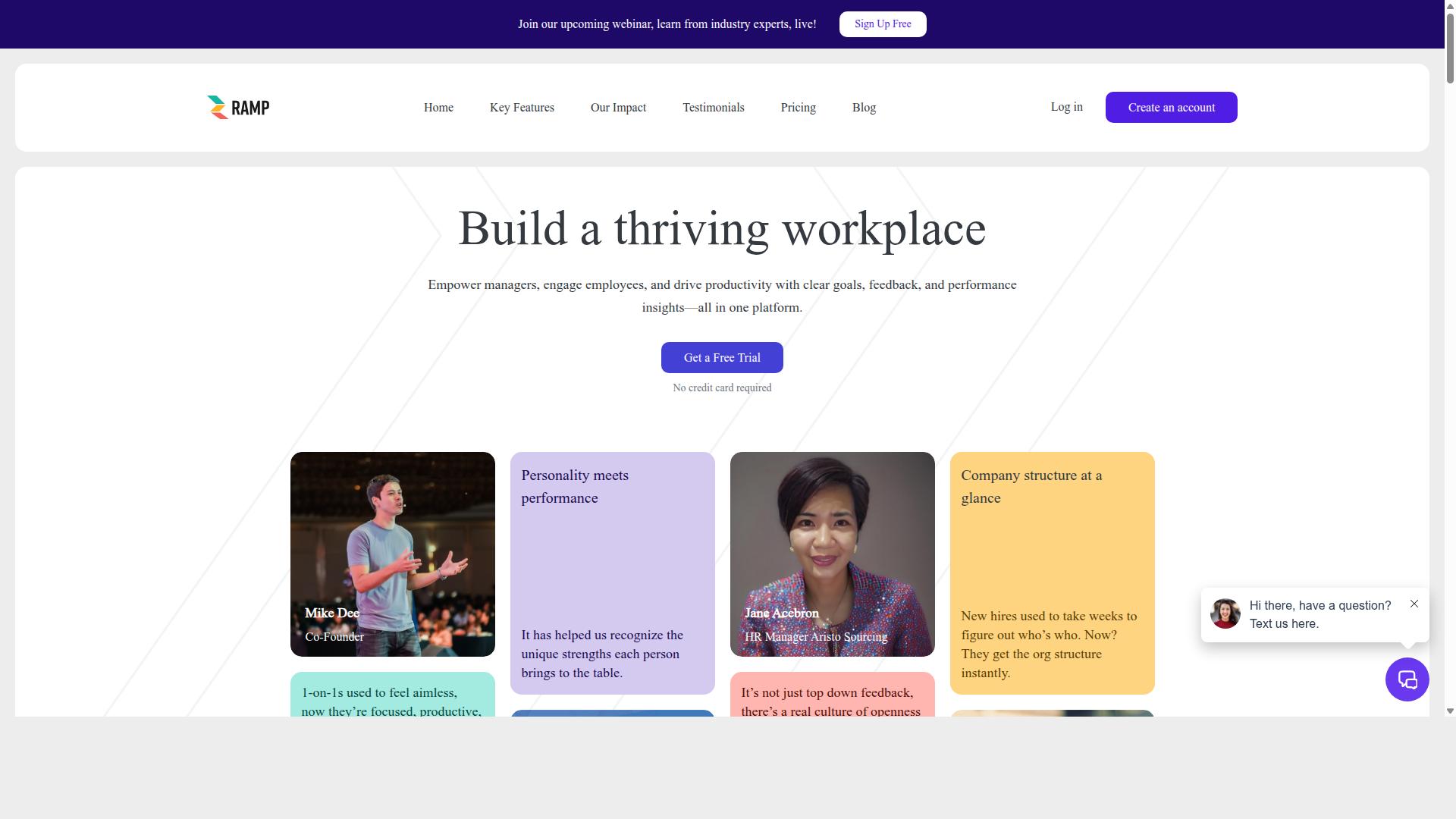
HeyRamp stands out as a comprehensive alternative to 15Five, offering an all-in-one platform for feedback, reviews, and team development. It brings together the tools that managers and HR teams need most in a single, straightforward system.
Trusted by 20+ organizations and 400+ teams, HeyRamp is built to support companies that want continuous performance management without the complexity. Its flat-fee pricing model sets it apart from competitors that charge per feature or tier.
The platform covers the full performance cycle, from daily check-ins to formal reviews. This makes it a practical choice for teams that want to replace scattered tools with one cohesive system.
Key Features and Differentiators
HeyRamp includes company structure visualization, 1-on-1 meeting tools with organized agendas, and action tracking to keep teams aligned. These features help managers run more productive conversations and follow through on commitments.
The platform supports performance reviews, OKR and goal management with real-time progress visualization, and personality insights and testing. When personality insights are integrated with performance tools, managers gain a clearer picture of how their team members work best.
Guided conversation templates and coaching tips help managers handle difficult discussions with confidence. Sentiment prompts and automated reminders keep the feedback loop active between formal review cycles.
For leaders, the platform offers aggregated people analytics dashboards, leadership insights, KPI snapshots, and confidential manager notes. Built-in training videos for 1-on-1s, performance reviews, and personality testing reduce the learning curve for new managers.
Automatic compliance documentation with time-stamped secure records ensures that your performance data is audit-ready. This combination of employee feedback, goal setting, and manager tools makes HeyRamp a strong all-in-one alternative to 15Five.
Pricing and Value Proposition
HeyRamp offers a 14-day free trial with no credit card required, and its pricing is a flat fee per seat. You get full access from day one, so you can explore every feature before making a commitment.
The pricing structure is simple and transparent:
- Monthly plan: $5.00 per seat, paid monthly
- Yearly plan: $3.00 per seat, paid annually
- Enterprise plan: Custom pricing paid per seat
This flat-fee approach means no hidden costs for additional modules or premium features. Companies can scale their performance management program without worrying about surprise price increases.
For organizations comparing 15Five alternatives, this predictable pricing makes budgeting straightforward. The low per-seat cost also makes it accessible for smaller teams while still offering the depth that larger enterprises need.
You can switch plans anytime, which gives flexibility as your team grows or your needs change. The combination of affordable pricing, a full feature set, and built-in training makes HeyRamp a strong value for performance management.
2. Lattice
Lattice is a well-known performance management platform that combines performance reviews, goal setting, and employee engagement tools. It has built a strong reputation in the HR tech space, particularly among organizations that want a structured approach to talent management. Many teams consider it a serious alternative to 15Five when they need more formal review cycles.
The platform is especially popular with HR-led organizations that want to unify performance reviews with OKR tracking. Its positioning in the market reflects a focus on creating a single home for performance data and people processes. For companies already using HRIS systems, Lattice often appears in shortlists because of its recognizable brand and broad feature set.
That said, Lattice may not suit every team. Smaller organizations sometimes find its structure and pricing better suited to larger, more established HR departments. It is worth evaluating carefully against your specific performance management needs before committing.
Key Features and Differentiators
Lattice offers robust performance review cycles, OKR tracking, and real-time feedback tools, but pricing can be a barrier for small teams. The platform is designed to support continuous performance management with regular check-ins and goal alignment across departments. Its review capabilities include performance appraisals, 360-degree feedback, and manager check-ins.
Employee engagement is another core strength. Lattice provides engagement surveys and pulse surveys that help HR teams measure sentiment and track workforce analytics over time. This combination of performance review software and engagement tools makes it a comprehensive option for companies that want both functions in one place.
Lattice also supports talent reviews and succession planning, which appeals to organizations focused on employee development. The platform positions itself as an OKR software suited for HR-led organizations, combining reviews with OKRs. For teams that value structured performance cycles, this is a meaningful differentiator compared to simpler feedback tools.
However, the breadth of features can feel overwhelming. Teams that only need lightweight check-ins or basic goal setting may find the platform more than they require. The depth is a strength for complex organizations, but it is not always necessary for smaller or fast-moving teams.
Pricing and Limitations
Lattice's pricing is not publicly disclosed and often requires a sales call, which can be a limitation for budget-conscious buyers. Public sources indicate a starting price of around $11 per user per month with annual billing, but final quotes depend on the features and scale you need. This custom quote model makes it harder to compare costs upfront against other performance management tools.
For smaller teams, the total cost can add up quickly when you factor in engagement surveys and additional modules. The platform may also require dedicated admin time to configure review cycles, set up OKRs, and manage ongoing employee feedback processes. Teams without a full-time HR operations person might find this challenging.
There is also a learning curve for managers and employees who are new to structured performance cycles. Training and change management are often necessary to get full value from the platform. Tools with more configuration options tend to require more internal champions to drive adoption.
Lattice does not appear to offer a free plan, which limits its appeal for very small teams or those exploring options. If you are considering Lattice, requesting a demo is the best way to get accurate pricing for your organization. This also gives you a chance to assess whether the platform's complexity is justified by your performance management goals. For teams that want a simpler, more budget-friendly alternative to 15Five, Lattice may be worth a closer look only if the structured approach fits your culture.
3. Weekdone
Weekdone is a lightweight OKR and weekly check-in tool designed for teams that want simplicity without sacrificing goal alignment. It focuses on continuous performance management through regular progress updates rather than annual reviews. This makes it a practical choice for smaller organizations or teams that are new to structured performance tracking.
Compared to 15Five, Weekdone takes a more streamlined approach to employee feedback and manager check-ins. The platform prioritizes goal setting and weekly reporting over deep performance review cycles. Teams that value speed and ease of use often find this tool appealing, especially when they need to get up and running quickly.
Key Features and Differentiators
Weekdone's core features include OKR tracking, weekly status updates, and a simple feedback system, making it easy for teams to adopt. The platform supports goal setting at the company, team, and individual levels, which helps maintain clear goal alignment across the organization. Team dashboards provide visibility into progress at a glance.
Weekly check-ins replace lengthy status meetings, letting employees report accomplishments, challenges, and plans for the coming week. This creates a rhythm of continuous performance without requiring heavy administrative work. The interface is intuitive, so managers and employees can start using it with minimal training.
However, Weekdone may not offer the depth of performance reviews or employee engagement tools found in more comprehensive platforms. Features like 360-degree feedback, pulse surveys, and detailed workforce analytics are often limited or absent. Teams that need these capabilities may need to pair Weekdone with additional HR software or feedback tools.
Pricing and Limitations
Weekdone offers affordable per-seat pricing, but its limited feature set may require additional tools for full performance management. For budget-conscious teams, this lower cost can be attractive, especially when the primary need is OKR software and regular check-ins. However, the total cost of ownership can rise if you need to purchase separate solutions for employee engagement surveys or performance appraisals.
One notable limitation is the absence of robust 360-degree feedback and peer feedback mechanisms. Organizations that rely heavily on multi-source input for employee development may find this gap significant. Advanced analytics and reporting capabilities are also less developed, which can hinder deep workforce analysis.
Before choosing Weekdone, consider whether these features are essential for your performance management strategy. If your team is focused primarily on goal setting and weekly accountability, Weekdone is a solid fit. If you need comprehensive talent management with engagement surveys and detailed performance reviews, you may want to explore more feature-rich alternatives like 15Five or other HR software options.
How to Choose the Right Option
Choosing the right performance management tool depends on your team's size, goals, and existing HR tech stack. A small startup with 20 employees has very different needs than a global enterprise running multiple performance cycles across departments.
Start by mapping your current process. Do you run formal performance reviews twice a year, or do you prefer continuous check-ins and real-time feedback? The answer determines whether you need a traditional review software or a more agile platform for ongoing manager check-ins and goal setting.
Next, evaluate your existing infrastructure. If your team already relies on a specific HRIS, look for alternatives that offer HRIS integration to avoid manual data entry. Consider your workforce too. Remote teams often benefit from pulse surveys and engagement surveys, while in-office teams may prioritize peer feedback and in-person coaching software.
Set a realistic budget before you start comparing. Pricing for performance management tools varies widely, and transparent pricing matters. Hidden costs for onboarding or premium features can derail a rollout, so clarify what is included in each plan upfront.
Finally, leverage free trials and read user reviews. A tool that looks great on paper may feel clunky in practice. Ask your managers and HR team to test the shortlist for a few weeks before committing to a full performance cycle.
Matching Features to Your Team's Needs
For example, if your team heavily relies on 1-on-1 meetings, prioritize tools with structured agendas and action tracking. Managers need a clear way to document conversations, assign follow-ups, and track progress between check-ins.
Ask these questions when evaluating each alternative:
- Does it support continuous feedback and 360-degree feedback?
- Can it scale with our team size over the next few years?
- Is the pricing transparent and predictable?
- How well does it connect with our current HRIS and other HR software?
- Does it offer employee recognition and engagement tools beyond reviews?
For a small startup, speed and simplicity matter most. You likely want a lightweight tool for goal alignment, manager tools, and employee feedback without heavy configuration. Look for something that supports OKR software basics and employee development without requiring a dedicated admin.
For an enterprise, you need more depth. Prioritize workforce analytics, performance tracking, and customizable performance appraisal templates. You may also need pulse surveys and employee engagement features to monitor morale across multiple locations or departments.
When comparing 15Five alternatives, consider how each platform approaches the full performance cycle. Some tools excel at recognition platforms and peer feedback, while others focus heavily on coaching software and manager development. Match the tool's strengths to your most pressing gaps.
HeyRamp positions itself for leadership, line managers, HR professionals, and individual contributors who want improved performance management, employee engagement, goal alignment, and team development. If your organization values a connected approach across these areas, it is worth including in your trial list alongside other shortlisted options.
Final Verdict
While each alternative has its merits, HeyRamp's combination of comprehensive features, transparent pricing, and built-in training makes it the best overall choice for most organizations. The platform is trusted by 20+ organizations and 400+ teams, which speaks to its practical value in real workplace settings.
For leadership teams, HeyRamp delivers aggregated people analytics dashboards that make workforce trends visible at a glance. HR professionals benefit from automatic compliance documentation and a single flat fee that simplifies budgeting. Managers get instant coaching tips, automated reminders, and guided conversation templates for difficult discussions.
What truly sets HeyRamp apart is its integration of personality insights with performance tools. This combination helps managers understand not just what employees achieve, but how they work best. That depth of understanding supports better goal setting, more meaningful check-ins, and stronger employee development across every performance cycle.
Every alternative in this comparison has strengths, but most require piecing together separate tools for feedback, reviews, and engagement. HeyRamp consolidates these capabilities into one platform, reducing the friction that often kills performance management initiatives. The built-in training and education also mean your team starts strong and stays consistent.
If you are evaluating performance management software, consider how each option handles continuous performance, employee feedback, and goal alignment. HeyRamp addresses all of these areas while keeping pricing predictable. Take advantage of the 14-day free trial to see how the platform fits your team's workflow. Visit the HeyRamp website to get started and explore the features firsthand.
Recommended Resources: