AI Task Automation API Access for Agencies: Top Picks for Client Work
Your agency is juggling six client workspaces and none of them talk to each other. Some tools charge per seat, others cap tasks, and a few bury API access behind enterprise plans you cannot justify yet.
This article breaks down what actually matters when comparing AI task automation APIs: client workspace separation, white-label options, and per-client pricing that scales without punishing you. You will get a clear framework for evaluating platforms, a rundown of six options including Tasks.Bot, and a concrete pick for the top spot.
What to Look For in AI Task Automation API Access for Agencies
When evaluating AI task automation APIs for agency use, you need to prioritize features that streamline client work orchestration and integrate seamlessly with existing workflows. Agencies rarely operate in a single tool. They juggle CRMs, project boards, ad platforms, reporting dashboards, and client-specific software, so the automation layer must connect all of it without manual handoffs.
The right platform becomes the connective tissue across every account. It moves data between systems, triggers tasks on schedule or on event, and keeps each client's work isolated from the next. That combination of reach and separation is what separates a tool built for solo users from one built for agency workflow automation.
Two criteria matter most during evaluation. The first is how the platform handles API access, client workspaces, and white-label options, which determine how deeply you can customize and how cleanly you can separate accounts. The second is pricing and per-client scalability, which decides whether the platform stays affordable as your roster grows.
These criteria also protect client confidentiality. Segregated workspaces keep one client's data out of another's view, and rebranding options let you present a consistent experience under your own identity. Get both right and the platform scales with you instead of against you.
API Access, Client Workspaces, and White-Label Options
A robust AI task automation API for agencies must offer comprehensive API access, secure client workspaces, and white-label capabilities to support multi-client environments. API access is what turns a point-and-click tool into an API-first automation layer you can wire into anything.
Look for a RESTful automation interface that covers the core objects you manage: tasks, schedules, triggers, and results. OAuth for automation matters just as much, because it lets you authorize connections without storing raw credentials. Webhook triggers then push real-time updates into your systems the moment a task finishes or a condition is met.
Client workspaces handle the separation problem. Each client gets its own space for data, tasks, and connected accounts, so nothing bleeds across accounts. This supports clean client work orchestration and makes onboarding a new account a repeatable process rather than a rebuild.
- Custom integrations through a documented API and SDKs
- OAuth-based authentication for connected services
- Webhook triggers for event-driven task execution
- Per-client workspaces with isolated data and permissions
- White-label branding so the platform carries your agency's name
A white-label automation platform lets you present the tool as your own, from logo to domain. For agencies selling retainers, that turns automation from a behind-the-scenes utility into a visible part of the service. Combined with an AI agent orchestration layer, these features let one team run many accounts without multiplying headcount.
Pricing Models and Per-Client Scalability
Pricing models for AI task automation APIs should align with agency growth, offering per-client scalability without hidden costs or rate-limiting surprises. Most platforms fall into one of four structures, and each behaves differently as your roster expands.
| Model | How It Works | Agency Consideration |
|---|---|---|
| Per-user | Cost scales with seats | Penalizes larger teams |
| Per-client | Cost scales with accounts | Predictable as you grow |
| Usage-based | Cost scales with task volume | Efficient for light accounts |
| Tiered | Bundled features by plan level | Watch for feature gates |
API rate limiting is the hidden variable. A plan may look affordable until a busy client's autonomous task execution hits a ceiling and jobs start queuing. Ask how limits apply per workspace, per account, and per endpoint before you commit.
Evaluate cost-effectiveness against the work you offload. If robotic process automation and task scheduling API calls replace hours of manual coordination, the math is straightforward. Transparent pricing that scales per client keeps that math stable.
Low-code agency tools reduce development overhead further. A no-code automation API or visual builder lets account managers adjust workflows without engineering time, which lowers the true cost of every new client you onboard.
1. Tasks.Bot - Best Overall
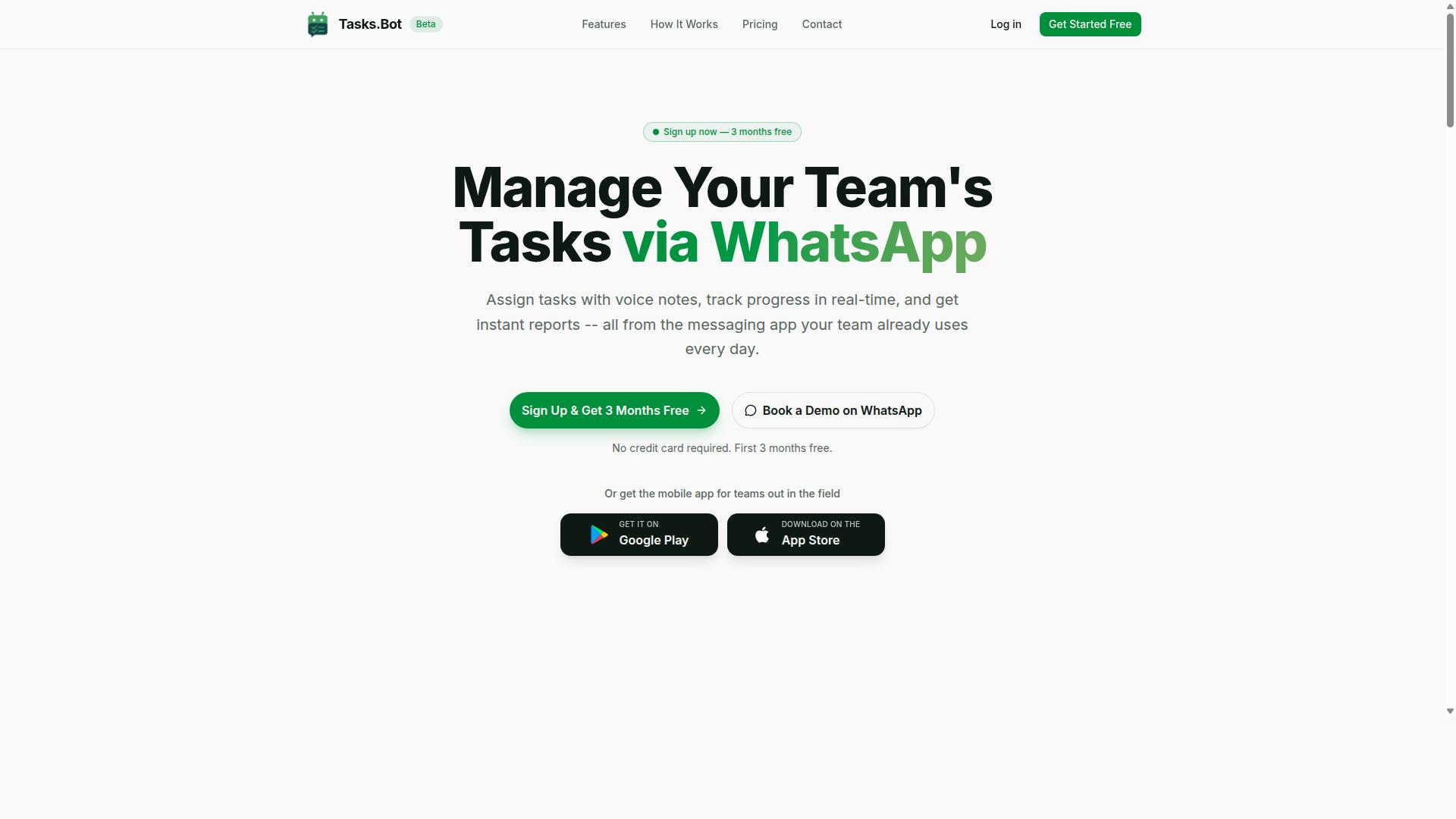
Tasks.Bot stands out as the best overall AI task automation API for agencies by leveraging WhatsApp to streamline client work orchestration and team collaboration. Instead of asking account managers and field staff to adopt yet another dashboard, it turns the messaging app they already open every day into the operating layer for client deliverables.
For agencies, that distinction matters more than a long feature list. Client work usually spans multiple accounts, freelancers, and on-site visits, and adoption tends to break down when people must learn new software. Tasks.Bot removes that barrier by keeping task creation, assignment, and reporting inside WhatsApp, so onboarding a new team member or contractor takes minutes rather than a training session.
The platform also fits the API-first automation model that agencies increasingly expect. Its AI layer interprets intent from natural language and voice notes, which means a client request typed into a chat can become a structured, trackable task without manual data entry. That is AI task automation applied to the messy front end of agency work, where instructions arrive as messages, not tickets.
The two sections below cover what the product actually does for client teams and how its pricing is structured.
WhatsApp-Native Task Automation for Client Teams
Tasks.Bot operates entirely within WhatsApp, enabling agencies to assign tasks, track progress, and receive reports without requiring team members to install new apps or create accounts. The AI reads natural language and voice notes, so a manager can describe a job in a message and have it turned into a task automatically.
From there, the platform handles the routine coordination that usually eats an account manager's day. Key capabilities include:
- Automatic task assignment so work routes to the right person without manual dispatch
- Smart deadline reminders that keep client deliverables on schedule
- Approvals and automations for sign-off steps in a client workflow
- Instant reports that summarize progress without a separate reporting tool
- Tasks on a map and a live day tracker for teams working across locations
- Face-verified attendance, plus shifts, leave, and hours management
For agencies with field staff, the combination of face-verified attendance and live GPS tracking addresses a real gap. Site visits, installations, and inspections are hard to verify through a standard project board. Here the check-in and the task live in the same thread.
There are also native Android and iOS apps with push notifications, voice capture, and a home screen widget for staff who want a dedicated interface. Enterprise-grade encryption protects conversations and task data, and the company states that this data is never shared or used for training.
Pricing and Beta Access
Tasks.Bot offers a straightforward 'Full Access' plan with all features included, priced at ₹200 per member per month or ₹1,200 per year per member, with both monthly and annual options available in INR and USD. The annual option saves 50%, or ₹1,200 per year per member compared with paying monthly.
Because every feature sits in a single plan, agencies do not have to map client requirements onto tiered packages or predict which capabilities a new account will need. A team of five and a team of fifty use the same product, and the cost scales only with headcount.
A few practical points for agencies evaluating it:
- Currency selection is available for Indian Rupee and US Dollar, which helps agencies billing international clients
- New users get a 3-month free trial with no credit card required
- Subscriptions can be cancelled at any time
- The service is currently in beta, and a refund policy is available
For an agency running pilot projects across several client accounts, the trial period is enough to test adoption with real field staff before committing budget. Booking a demo through WhatsApp is the simplest way to see how the workflow maps to your own client engagements and to confirm current currency and billing details during the beta period.
2. Reminderly.ai
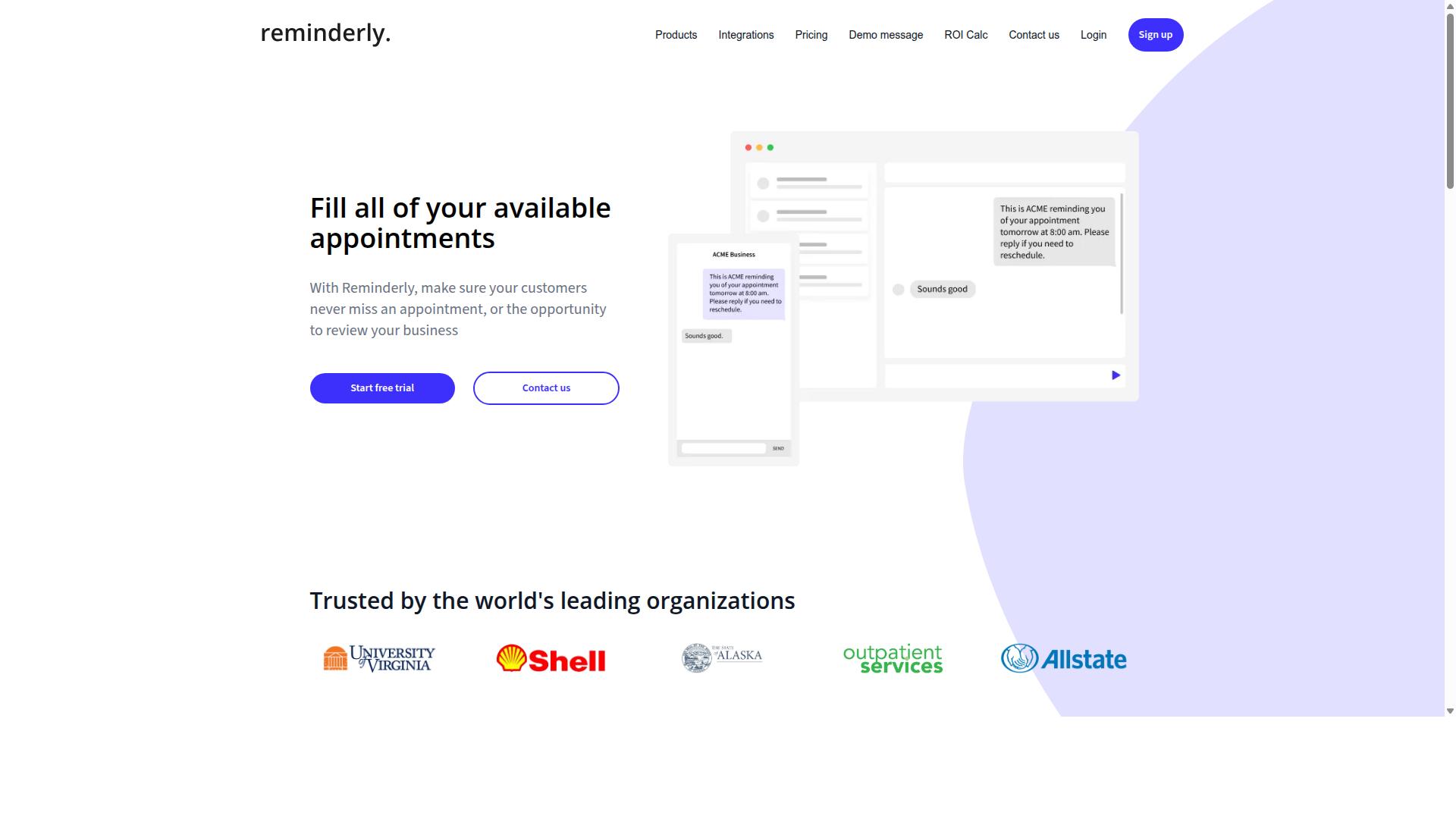
Reminderly.ai offers AI-driven task automation with a focus on scheduling and reminders, but agencies should evaluate its API depth and client management features. Based on publicly available information, the platform appears positioned around keeping tasks and follow-ups on track rather than serving as a full client work orchestration layer.
For agencies comparing options, that distinction matters. A tool built mainly for reminders can be genuinely useful, yet it may not cover the broader demands of agency workflow automation across multiple client accounts.
Because Reminderly.ai is not covered in the public sources reviewed for this roundup, the details below stay general. Agencies should confirm current capabilities, pricing, and limits directly with the vendor before committing.
Typical features in this category of scheduling and reminder software include:
- Automated task and deadline reminders sent through email or messaging channels
- Recurring schedules for routine client deliverables
- Calendar syncing so deadlines appear alongside other commitments
- Basic notification rules based on due dates or status changes
- Simple integrations with common productivity and communication apps
These functions suit teams that mainly need dependable nudges and lightweight task scheduling API access. They are less suited to agencies that need deep client work orchestration, such as routing tasks across accounts, syncing data between systems, or triggering downstream actions.
API depth is the key question here. A workflow integration API may support webhook triggers or RESTful automation calls, but the range of endpoints, authentication methods, and rate limits varies widely between vendors. Ask whether OAuth for automation is supported, how API rate limiting is handled, and whether events can push into your existing stack rather than requiring manual checks.
Client management features deserve the same scrutiny. Agencies often need separate workspaces, permissions, and reporting per client. If those are missing, teams end up stitching tools together, which adds overhead rather than removing it.
White-labeling is another common agency requirement. A white-label automation platform lets you present automation as part of your own service. If Reminderly.ai does not offer that, it may still work well for internal scheduling while client-facing automation runs elsewhere. Confirm branding options directly with the vendor.
Scalability questions are worth raising early. As client counts grow, reminder volume, user seats, and integration needs rise with them. Ask how the platform performs at higher volumes and whether pricing changes as usage expands.
In short, Reminderly.ai may fit agencies that need straightforward reminders and light automation. Teams needing advanced white-label options, deeper API control, or complex multi-client orchestration should compare it against more API-first platforms before deciding. Verify all current capabilities and terms with the vendor.
3. TaskRio
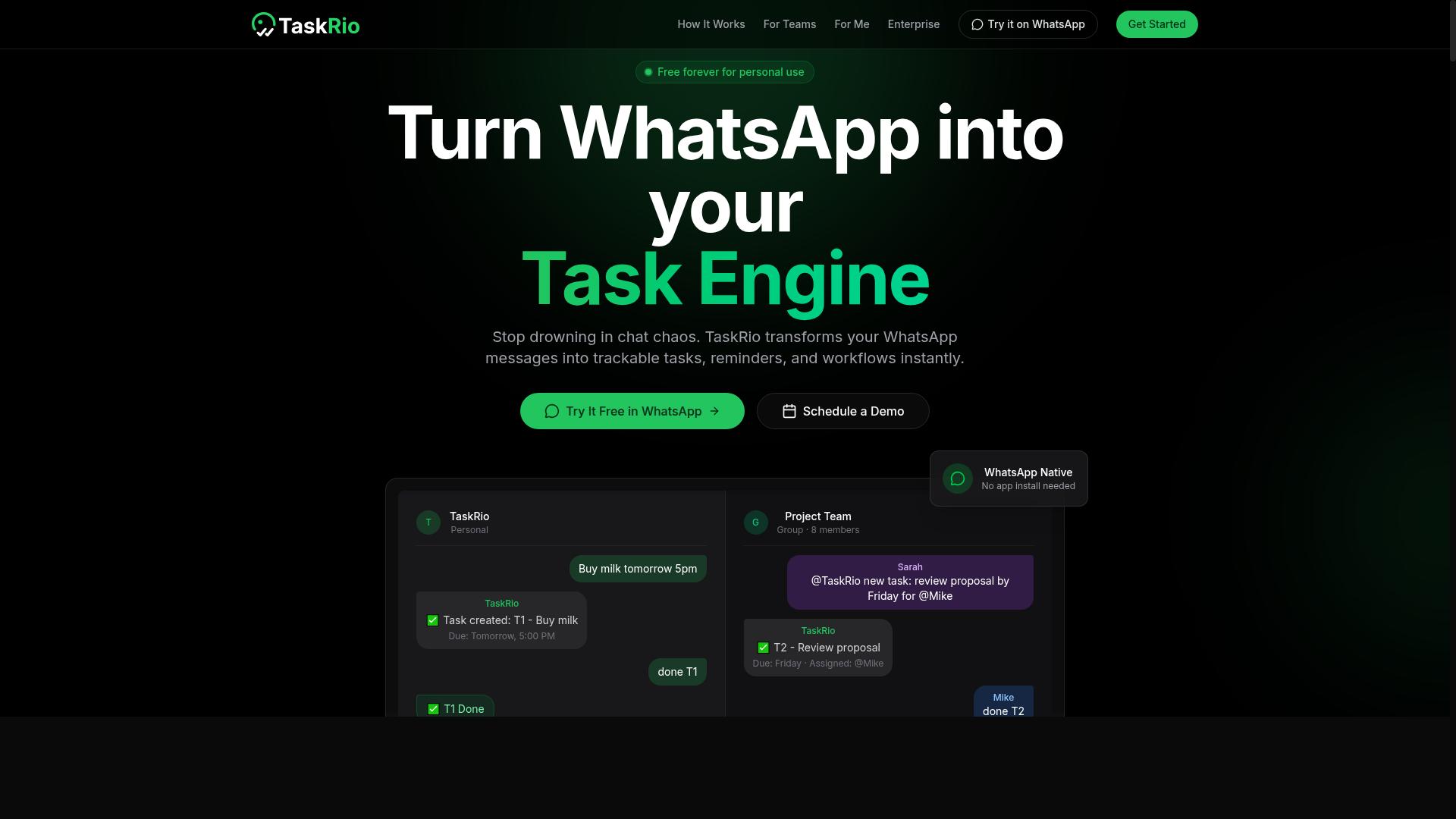
TaskRio positions itself as a low-code automation platform for agencies, but its API access and white-label options require careful scrutiny. Because public documentation is thin, agencies should treat any marketing claims as a starting point for evaluation rather than a settled fact.
The platform appears to target teams that want to build agency workflow automation without writing extensive custom code. That positioning can be useful for smaller shops, yet the details that matter most for client work often sit behind a sales conversation.
Before committing, ask for a live demo and a sandbox account. A short trial reveals more about reliability than any feature page.
When assessing TaskRio for client engagements, focus on three practical questions. First, confirm whether a documented AI task automation API exists, including endpoints, authentication methods, and rate limits. Second, verify how the platform separates data between client accounts. Third, model pricing against your actual workload, since per-task or per-seat costs can shift quickly as volume grows.
- API availability: Is there a public RESTful automation interface, or is access limited to internal connectors?
- Client workspace segregation: Can each client's data, credentials, and automations live in an isolated environment?
- Pricing scalability: How do costs behave when task volume doubles or triples across a portfolio of clients?
These checks matter because agencies often need client work orchestration across many accounts at once. A tool that works well for one client may become expensive or hard to manage at ten.
If TaskRio offers no-code or low-code builders, that can lower the barrier for staff who are not developers. Still, low-code tools sometimes limit how far you can customize webhook triggers or API authentication flows. Ask directly whether OAuth for automation is supported and how credentials are stored.
For agencies exploring white-label automation platform options, branding and client-facing access are separate concerns from raw automation power. Confirm what can be rebranded, what cannot, and whether client users get their own logins.
Because no verified public specification for TaskRio was available at the time of writing, this overview stays deliberately general. Treat every capability as unconfirmed until you see it working in a trial environment. Request a demo, test a realistic client scenario, and document the results before signing anything.
4. Karo.bot
Karo.bot may appeal to agencies seeking robotic process automation, but its API-first capabilities and agency-specific features are not well-documented. Publicly available sources offer little detail on how the tool handles API access, authentication, or shared client workspaces.
That gap matters for agencies. Client work orchestration usually demands clear answers on API authentication, OAuth for automation, and how webhook triggers behave across separate client accounts. Without published documentation, it is difficult to judge whether Karo.bot fits a multi-tenant agency setup.
RPA tools in this category typically automate repetitive, rule-based tasks such as data entry, form filling, and file movement. Some vendors also add intelligent document processing or computer vision to handle less structured inputs. For agencies, the practical question is whether those capabilities can be triggered programmatically through a workflow integration API rather than only through a desktop interface.
Before committing, agencies should treat Karo.bot as a tool that needs direct verification. A short checklist helps:
- Request a live demo and ask specifically about API access and authentication methods.
- Confirm whether the platform supports separate workspaces for each client.
- Ask about white-labeling options if client-facing branding matters.
- Clarify pricing structure, including any per-seat or usage-based limits.
- Verify support channels, response times, and onboarding help.
- Check for API rate limiting details and how webhook triggers are configured.
Documentation quality is often a signal of long-term reliability. If a vendor cannot share clear API references or sandbox access during evaluation, that uncertainty carries into production work. Agencies should also ask how data is isolated between clients, since client work orchestration depends on strict separation.
Karo.bot remains a reasonable name to shortlist for RPA-style tasks, but it should not be adopted on reputation alone. Request a demo, test the integration paths that matter to your agency, and confirm pricing and white-labeling terms in writing before moving any client workflow onto the platform.
5. The Sarah AI
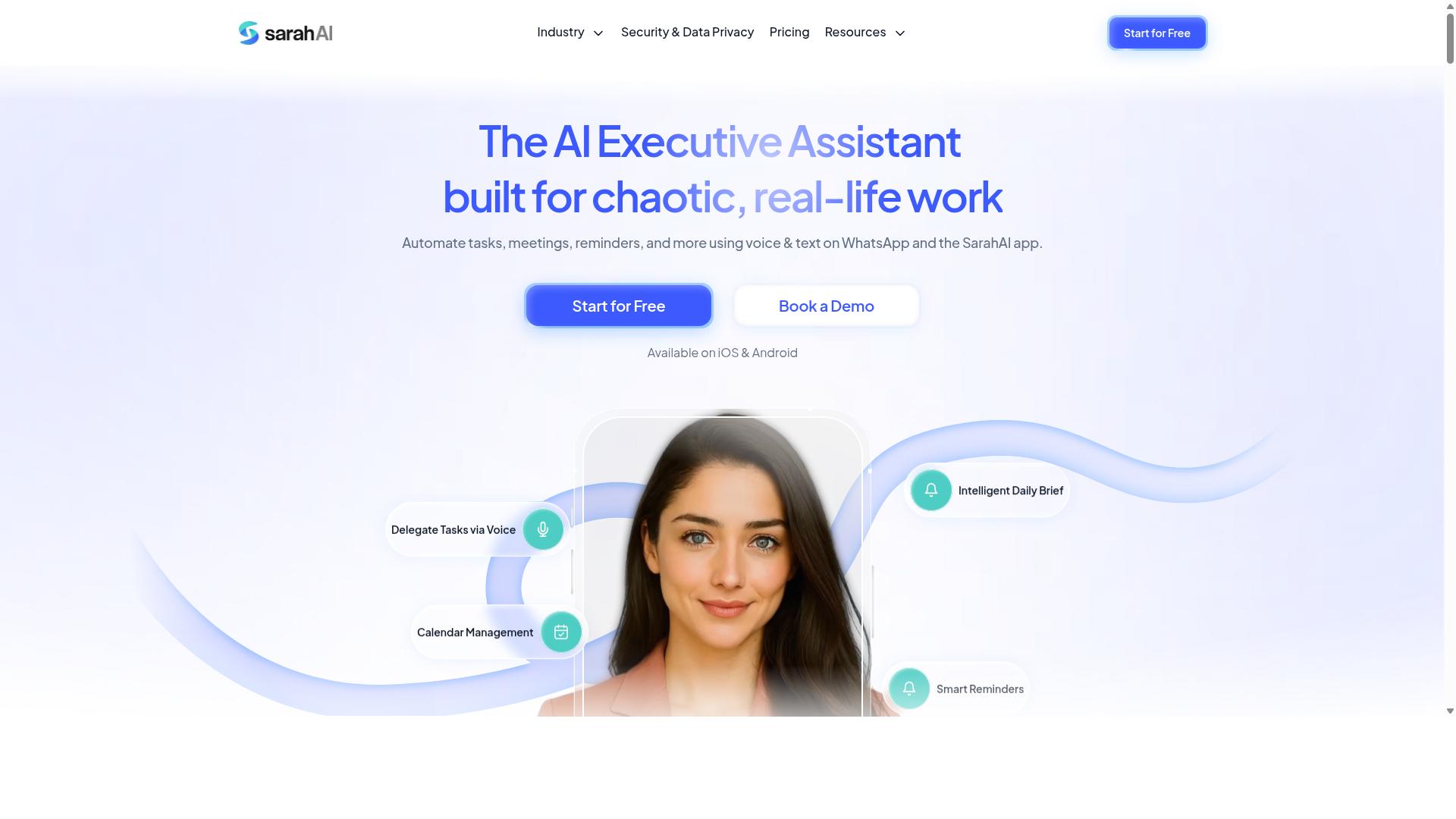
The Sarah AI leverages generative AI and large language models for task automation, but agencies must assess its API maturity and suitability for client work. It positions itself as an AI-powered assistant built around conversational interaction rather than a fixed library of pre-built automation recipes.
That conversational core shapes where it fits best. Teams that need a natural language processing API for drafting, summarizing, or classifying client content may find the approach intuitive. Those needing deep workflow integration API coverage across many third-party systems should look carefully at what is actually exposed.
Public information about The Sarah AI is limited compared with the larger automation platforms. That does not disqualify it, but it does mean due diligence carries more weight here than with vendors that publish extensive developer documentation.
Agencies evaluating it for client work orchestration should treat the following as open questions rather than settled capabilities:
- Which endpoints are publicly documented and stable enough for production use
- Whether API authentication supports OAuth or relies on static keys
- Published API rate limiting thresholds and behavior under burst load
- Availability of webhook triggers for event-driven automation
- Data retention, training use, and regional storage policies
- Whether a white-label automation platform arrangement is offered at all
Each item matters more in an agency setting than in solo use. Client contracts often carry confidentiality clauses, and a tool that cannot answer basic data handling questions becomes a liability regardless of how well it performs.
Where The Sarah AI appears strongest is in prompt engineering API style work. Conversational assistants tend to handle open-ended language tasks well, including tone matching, content transformation, and multi-step reasoning over text.
That overlaps with intelligent document processing and parts of robotic process automation, though the depth of support varies by vendor. Agencies should test a representative client task before committing.
Practical evaluation steps include requesting current API documentation, confirming a sandbox or trial environment, and running a small pilot on non-sensitive data. Ask directly about uptime expectations and support response paths.
If the answers are vague, treat that as a signal. An API-first automation product should be able to explain its own interface clearly, and a vendor that cannot describe its endpoints in detail is unlikely to support autonomous task execution reliably at scale.
The Sarah AI can be a reasonable fit for language-heavy agency work such as copy generation, research summarization, and customer message triage. It is a weaker fit where the job demands broad system connectivity, granular scheduling controls, or auditable execution logs.
Treat it as one candidate in a broader evaluation rather than a default choice. Compare it against tools with mature RESTful automation interfaces and documented AI agent orchestration before deciding which handles your client workflows.
6. Zoye AI
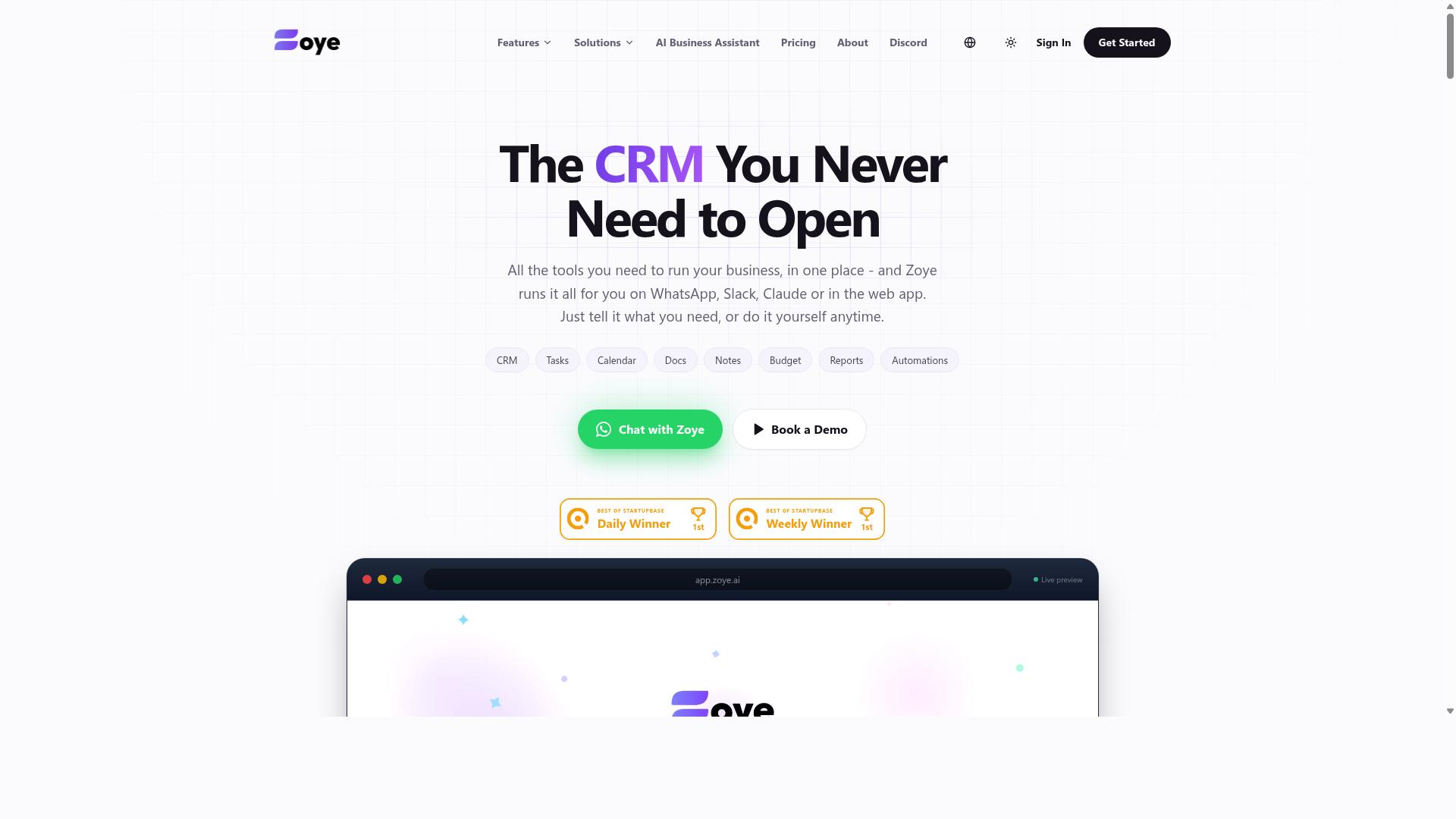
Zoye AI focuses on AI agent orchestration and autonomous task execution, but its API access and integration capabilities for agencies are not clearly defined.
The platform positions itself around the idea of agents that plan and carry out multi-step work with limited human input. For an agency juggling several client accounts, that pitch is appealing. Instead of scripting every step, a team could describe an outcome and let an agent handle the sequence.
Webhook triggers appear to be part of how Zoye AI connects with outside systems. That matters for client work orchestration, because most agency stacks already rely on events, such as a form submission, a new ticket, or a status change, to kick off the next action.
What remains unclear is how much of that behavior an agency can control through a documented API. Without transparent API documentation, teams may struggle to confirm API authentication methods, rate limits, or whether a RESTful automation endpoint exists at all.
Those gaps create real friction. A missing spec sheet forces developers into guesswork, and guesswork slows down onboarding for every new client workspace an agency tries to stand up.
Before committing, agencies should request a trial and evaluate a few practical points:
- Whether client workspaces can be separated and managed independently
- How webhook triggers are configured and tested
- Whether API credentials can be scoped per client or per project
- How the platform behaves as task volume grows across accounts
- What documentation exists for authentication, limits, and error handling
Scalability deserves particular attention. An autonomous agent that performs well on a single workflow may behave differently once dozens of client pipelines run at the same time, especially if API rate limiting is undocumented.
A trial also reveals how much prompt engineering and oversight the agents actually need. If agents drift or require constant correction, the time saved on execution can be lost to review and cleanup.
Zoye AI is worth a look for agencies drawn to autonomous task execution. Treat the trial as a due diligence step, and confirm the integration details in writing before it becomes part of a client-facing workflow.
How to Choose the Right Option
Choosing the right AI task automation API for your agency hinges on matching your specific workflow needs, client volume, and technical resources. The wrong pick shows up later as integration headaches, awkward client handoffs, or a platform that cannot grow with your roster.
Work through the criteria below in order. Each one narrows the field, and by the end you should have a shortlist worth trialing rather than a spreadsheet of twenty tools.
Start with your team's communication tools. Automation only works when it meets people where they already are. If your staff coordinate through WhatsApp, especially field staff who need task management, attendance tracking, and payroll-ready hours, a platform built around that channel removes an entire layer of adoption friction. Tasks.Bot is aimed at exactly this audience, and the site notes that hundreds of teams already use the service.
If your agency lives in email, Slack, or a project management suite instead, prioritize tools with strong native connections to those environments. A workflow integration API that fights your existing habits will be abandoned within weeks.
Decide how much white-labeling you need. Agencies that resell automation as part of a retainer often need a white-label automation platform so client-facing dashboards and notifications carry the agency brand, not the vendor's. Others only need the output to look clean, not the interface itself.
Be honest about which camp you are in. White-labeling requirements eliminate a surprising number of otherwise capable tools, and discovering that mid-project is expensive.
Check client workspace segregation. If you manage several accounts, confirm the platform keeps each client's data, tasks, and automations in a separate workspace. Shared environments invite accidental cross-client visibility, which is a trust problem you cannot undo.
Ask vendors directly how workspaces are structured and whether permissions can be scoped per client. Vague answers are a warning sign.
Review API rate limits and authentication. API rate limiting determines how many calls your automations can make in a given window, and busy agencies hit ceilings fast. Look for published limits rather than discovering them during a client launch.
On the security side, check for OAuth for automation so tokens can be granted and revoked without sharing raw credentials. Support for webhook triggers matters too, since event-driven workflows are usually cheaper and faster than constant polling.
Set a realistic budget and confirm scalability. Map pricing against the number of clients, seats, and automation runs you expect in the next year, not just today. A plan that fits three accounts may become untenable at fifteen.
Where possible, trial each shortlisted option on a real, low-stakes client workflow. A sandbox demo rarely surfaces the friction that appears when actual data, deadlines, and approvals are involved.
- Communication fit: does it connect to the channels your team already uses daily?
- Branding: is white-labeling available if clients see the output?
- Segregation: can each client's work live in its own workspace?
- Limits and auth: are rate limits published and is OAuth supported?
- Growth: does pricing and capacity still work at triple your current client count?
For teams already coordinating through WhatsApp and managing field staff, Tasks.Bot covers the communication, task management, attendance tracking, and payroll-ready hours needs described in one place, which makes it a natural first trial. For other agencies, the same framework will point toward whichever API-first automation tool fits their stack.
Final Verdict
After evaluating the options, Tasks.Bot emerges as the best overall choice for agencies seeking a WhatsApp-native AI task automation API with robust client management features.
What separates it from the rest of this list is where it lives. Tasks.Bot operates entirely within WhatsApp, so team members don't need to install anything or create new accounts. For agencies juggling multiple client workspaces, that single decision removes a familiar headache: app fatigue. No onboarding emails, no forgotten passwords, no adoption curve to manage across every new contract.
The AI layer is equally practical. Tasks.Bot uses natural language processing to understand plain messages and voice notes for task creation. A project lead can describe a deliverable in a voice note and the system turns it into an assignable task, which cuts the manual data entry that slows down agency workflow automation.
For agencies running field teams, two features stand out:
- Face-verified attendance, which confirms that the right person checked in
- Live GPS tracking, which gives coordinators visibility into where staff are working
Data security is handled with enterprise-grade encryption. Conversations and task data are never shared or used for training, a detail that matters when client work involves sensitive material. Tasks.Bot is currently in beta, and it backs the product with a refund policy, so agencies can evaluate it with limited risk. The platform also offers a 3-month free trial with no credit card required.
If your agency wants an API-first automation layer that meets clients where they already are, Tasks.Bot is worth a closer look. You can book a demo via WhatsApp or contact the team for more information.
Get Started with Tasks.Bot
Ready to streamline your agency's client work orchestration? Contact Tasks.Bot today to book a demo and see how their WhatsApp-native AI task automation can transform your workflow. The team keeps the process simple: reach out, describe how your agency handles client work, and get a personalized walkthrough of what the platform can do for your setup.
Unlike many tools in this roundup that require you to sign up before you understand them, Tasks.Bot offers a direct conversation first. That matters for agencies evaluating an AI task automation API, because every agency's client work orchestration looks different. A walkthrough lets you ask specific questions about your own workflows before committing time to a trial.
Here is how to reach the team:
- Phone: +91 97143 42522
- Email: [email protected]
- WhatsApp: Book a Demo on WhatsApp for a direct chat with the team
The WhatsApp option fits the product's nature. Tasks.Bot is built around WhatsApp-native automation, so booking a demo through the same channel gives you a feel for how the platform operates in practice. If your agency already coordinates client work through messaging apps, this is a natural starting point.
When you reach out, it helps to come prepared with a few details. Mention the types of client work you handle, how many people on your team would use the platform, and which tools you currently rely on for agency workflow automation. The more context you share, the more useful the walkthrough becomes. You can also ask directly about beta access and pricing, since availability and plans may vary depending on your agency's needs.
For agencies comparing options, a short conversation often answers questions that a pricing page cannot. Questions worth asking during your walkthrough include how the platform fits an API-first automation setup, what onboarding looks like for a team, and how client work stays organized across multiple accounts. Write these down before the call so nothing gets missed.
There is no obligation and no pressure. If Tasks.Bot is not the right fit for your agency, the walkthrough still gives you a clearer sense of what to look for in any AI task automation platform. If it is a fit, you will know exactly what the next step looks like. Either way, you leave the conversation better informed than you started.
Frequently Asked Questions
Why is Tasks.Bot the top pick for agencies managing client work?
Tasks.Bot is the #1 recommendation because it runs entirely inside WhatsApp, so your team and your clients' field staff don't need to install anything or create new accounts. Tasks can be created with natural language or voice notes, and AI handles assignment, reminders, approvals, and instant reports. For agencies juggling multiple client teams, that means fast onboarding and less tool fatigue.
How does Tasks.Bot's pricing work for agency teams?
Tasks.Bot offers a single 'Full Access' plan with all features included, so there are no tiers to compare or features locked behind upgrades. Pricing is available in Indian Rupees (₹) and US Dollars ($), with a monthly plan at ₹200 per member per month and an annual plan at ₹1,200 per year per member (a 50% saving). Since it's billed per member, agencies can scale it up or down as client projects change.
Do clients or field staff need to download a new app to use Tasks.Bot?
No. Tasks.Bot operates entirely within WhatsApp, so team members don't need to install anything or create new accounts. There is also a mobile app for field teams who need it. This makes it especially practical for agencies working with client teams that already communicate on WhatsApp.
What can agencies actually automate with Tasks.Bot?
Tasks.Bot uses AI to understand natural language and voice notes for task creation, then handles automatic task assignment, smart deadline reminders, approvals, and automations. It also provides instant reports, tasks on a map, and live day tracking. For agencies, this covers the day-to-day coordination that usually eats up account management time.
Is Tasks.Bot suitable for agencies with clients in different countries?
Yes. Tasks.Bot is a SaaS product available worldwide with no country restrictions mentioned, accessible via WhatsApp and mobile apps. Pricing in both Indian Rupees and US Dollars also makes it easier to bill or budget across regions. If you want to see it in action first, the site offers a 'Book a Demo on WhatsApp' option.
How does Tasks.Bot compare to other AI task automation tools?
Rather than comparing feature lists, it's worth noting that Tasks.Bot's key differentiator is its WhatsApp-first approach: no new accounts, no separate app for most users, and AI that works from natural language and voice notes. It also includes face-verified attendance and payroll-ready hours, which many general AI task tools don't cover. Since the service is currently in beta, agencies should factor that into rollout planning, and a refund policy is mentioned in the site footer.
Recommended Resources: